

Searching for the best Avalanche wallet? Avalanche is one of the fastest-growing blockchain ecosystems, known for its low fees, fast transactions, and strong support for decentralized applications. The network allows users to send AVAX, stake tokens, interact with DeFi protocols, and trade NFTs across a rapidly expanding ecosystem.
To safely store and manage AVAX, you’ll need a reliable Avalanche wallet. These wallets let you send and receive tokens, connect to dApps, and access DeFi platforms while keeping full control of your private keys.
In this guide, we compare the best Avalanche wallets in 2026, focusing on software wallets that offer the best balance of usability, staking support, and Web3 access. Each wallet has different strengths depending on whether you prioritize staking, DeFi, or simple everyday AVAX management.
If security is your top priority, you can also explore our full comparison of the best hardware wallets for Avalanche (AVAX) to find the most secure options for long-term storage.
Best Avalanche Wallets
- Core Wallet – Best Avalanche wallet for staking and native chain support
- MetaMask – Best Avalanche wallet for DeFi and C-Chain dApps
- Trust Wallet – Best beginner-friendly mobile AVAX wallet
- Nufi – Best multichain Avalanche wallet for browser users
- Exodus – Best AVAX wallet for ease of use across desktop and mobile
- Gem Wallet – Best simple mobile Avalanche wallet
1. Core Wallet – Best Avalanche wallet for staking and native chain support

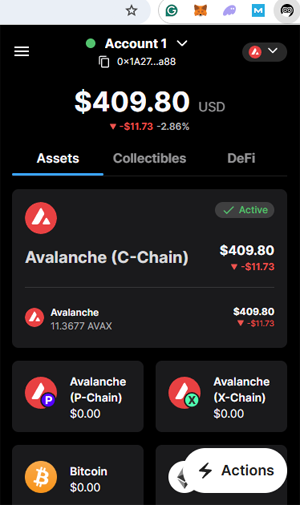
Core Wallet is the official non-custodial wallet for Avalanche, developed by Ava Labs. It supports Avalanche’s C-Chain, P-Chain, and X-Chain out of the box, making it one of the easiest ways to manage AVAX, stake tokens, and interact with the full Avalanche ecosystem without manual setup.
Available as a browser extension and mobile app, Core allows users to manage AVAX, view NFTs, explore dApps, and access Avalanche-native features from one interface. It is also one of the best wallet options for users who want direct support for Avalanche staking and subnet-related functionality.
For added security, Core can be paired with Ledger hardware wallets, allowing users to keep their private keys offline while still using Avalanche DeFi apps and staking features. For most AVAX holders, Core is the most complete software wallet option.
✅ Verdict
- Best for: Full Avalanche ecosystem access (staking, NFTs, dApps)
- Main strength: Native support for Avalanche chains and features
- Main drawback: Less familiar interface compared to MetaMask
- Who should use it: Users who want the most complete and “official” Avalanche wallet experience
2. MetaMask – Best Avalanche wallet for DeFi and C-Chain dApps

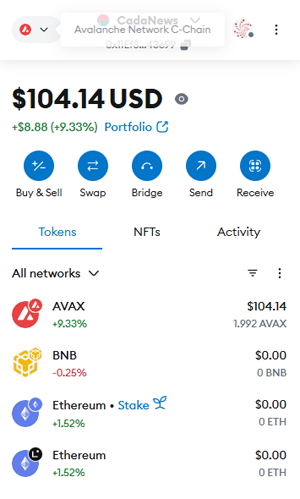
MetaMask is one of the most widely used browser wallets in crypto and remains a popular choice for accessing Avalanche C-Chain. While it was originally built for Ethereum, it can easily be configured for Avalanche and works well with DeFi platforms, NFT marketplaces, and other EVM-compatible applications.
Because Avalanche is compatible with Ethereum-style applications, MetaMask gives users a familiar way to interact with Avalanche dApps while benefiting from lower fees and faster confirmations. It is available as a browser extension and mobile app, making it convenient for both desktop and mobile users.
MetaMask is especially useful for traders, DeFi users, and anyone already comfortable with Ethereum wallets. For stronger protection, it can also be paired with Ledger hardware wallets, combining browser wallet convenience with cold storage security.
✅ Verdict
- Best for: Avalanche DeFi and C-Chain dApps
- Main strength: Seamless access to Web3 apps and EVM compatibility
- Main drawback: Requires manual setup for Avalanche and lacks native staking support
- Who should use it: Users already familiar with Ethereum wallets who want to use Avalanche DeFi, trading, and NFTs
3. Trust Wallet – Best beginner-friendly mobile AVAX wallet
Trust Wallet is a beginner-friendly mobile wallet that supports AVAX alongside thousands of other cryptocurrencies. With native support for Avalanche C-Chain, it gives users a simple way to buy, store, send, receive, and swap AVAX directly from their phone.
Its biggest strength is usability. Trust Wallet is easy to set up, requires no registration, and works well for users who want a simple mobile wallet without dealing with manual network configuration or more advanced settings. It also supports a broad range of assets, which makes it useful for multichain holders.
While it is not the most advanced Avalanche wallet for staking or deeper ecosystem access, Trust Wallet remains a solid option for beginners who want a clean and reliable mobile app for managing AVAX.
✅ Verdict
- Best for: Beginner-friendly mobile AVAX management
- Main strength: Simple setup and easy-to-use mobile interface
- Main drawback: Limited support for advanced Avalanche features like native staking
- Who should use it: New users who want a straightforward way to store, send, and manage AVAX on their phone
4. NuFi – Best multichain Avalanche wallet for browser users
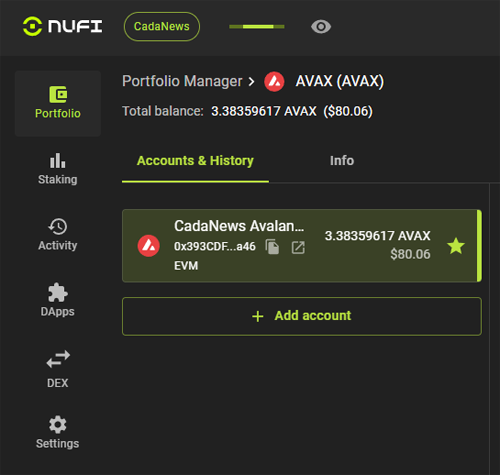
NuFi is a multi-chain wallet that supports Avalanche C-Chain and gives users access to AVAX, Avalanche dApps, and NFT management through a clean browser-based interface. It is available as both a web wallet and browser extension, making it easy to use across different devices.
The wallet is especially useful for users who want to interact with Web3 applications without limiting themselves to just one blockchain. In addition to Avalanche, NuFi supports other major ecosystems, which makes it appealing to users with diversified portfolios.
NuFi also supports hardware wallets such as Ledger, Trezor, and Keystone, allowing users to combine broader ecosystem access with stronger key protection. It may not be the top choice for native Avalanche staking, but it works very well as a front end for daily AVAX transactions and dApp usage.
✅ Verdict
- Best for: Multichain users who want Avalanche access in one wallet
- Main strength: Supports multiple blockchains with built-in dApp connectivity
- Main drawback: Not optimized for native Avalanche staking or advanced features
- Who should use it: Users managing assets across different networks who want a single wallet for Web3 access
5. Exodus – Best AVAX wallet for ease of use across desktop and mobile
Exodus is a polished multi-asset wallet that supports AVAX alongside hundreds of other cryptocurrencies. Available on desktop, mobile, and web, it is a convenient option for users who want a visually clean interface and simple portfolio management without needing a blockchain-specific wallet.
The wallet makes it easy to send, receive, and swap AVAX, and it works especially well for users who hold several different assets in one place. Its interface is one of the easiest to use, which makes it popular with beginners and casual investors.
Exodus is best for users who want a straightforward way to hold and manage AVAX as part of a broader portfolio. It is less suitable for users who need advanced Avalanche staking, NFT tools, or deep dApp integration.
✅ Verdict
- Best for: Easy AVAX management across desktop and mobile
- Main strength: Clean interface with built-in portfolio tracking and swaps
- Main drawback: Limited support for advanced Avalanche features and staking
- Who should use it: Users who want a simple, visually polished wallet for managing AVAX alongside other assets
6. Gem Wallet – Best simple mobile Avalanche wallet

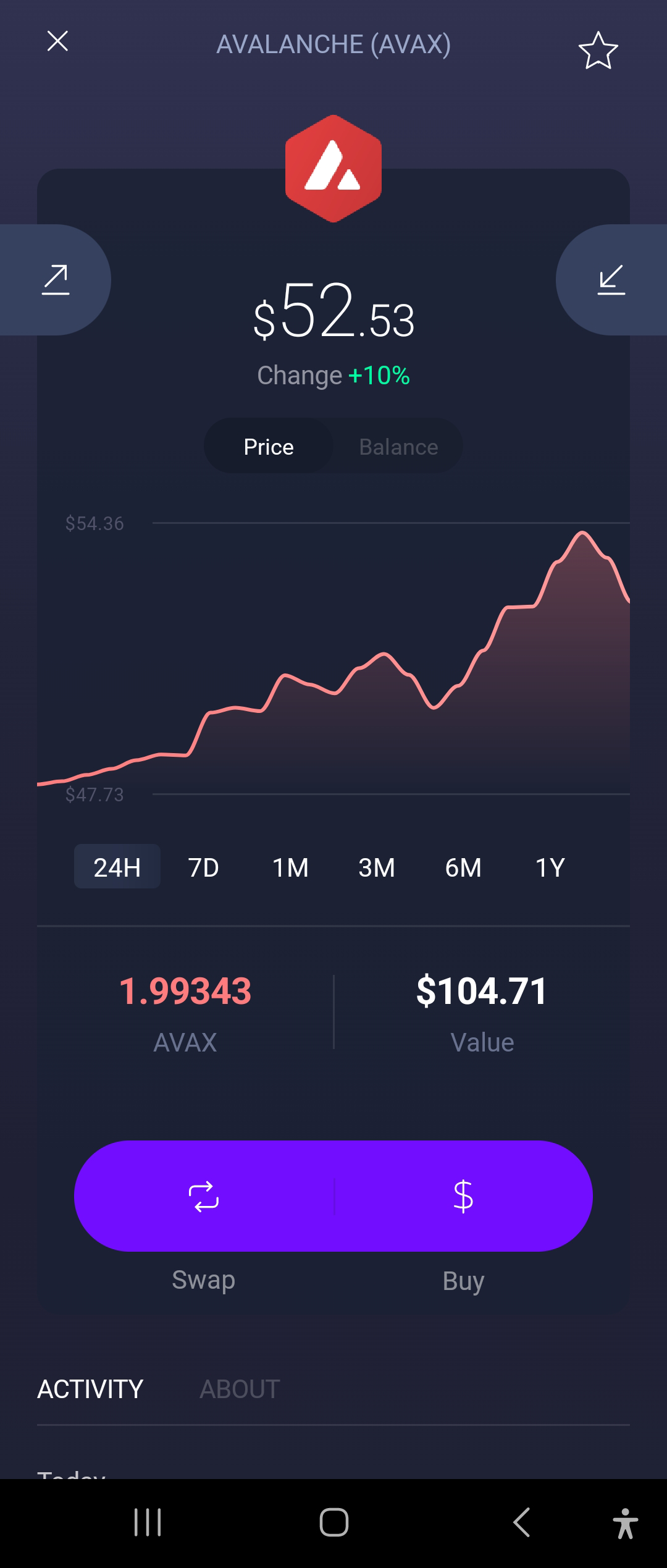
Gem Wallet is a lightweight mobile wallet designed for users who want a simple way to store and manage AVAX on iOS and Android. Its interface is minimal and easy to use, making it a practical option for users who want fast access to their assets without a complicated setup process.
The wallet supports sending, receiving, and swapping AVAX, and it also provides basic WalletConnect support for connecting to Avalanche dApps. That makes it more flexible than a simple storage wallet, even if it does not offer the same depth as Core or MetaMask.
Gem Wallet is best suited to mobile-first users who want a private, no-login wallet for AVAX and light Web3 access. It is not the strongest option for staking or advanced Avalanche features, but it works well for straightforward everyday use.
✅ Verdict
- Best for: Simple mobile AVAX storage
- Main strength: Lightweight app with quick setup
- Main drawback: Limited features compared to more advanced Avalanche wallets
- Who should use it: Mobile users who want a minimal, no-frills wallet for storing and managing AVAX
Why Avalanche Stands Out in 2026

Avalanche is a high-performance blockchain platform built by Ava Labs, known for its scalability, low fees, and fast transaction finality. Designed to compete with Ethereum, Solana, and Polkadot, Avalanche supports decentralized applications (dApps), NFTs, and DeFi protocols.
The network can process thousands of transactions per second and achieves near-instant finality. Developers are drawn to its Ethereum compatibility, low gas fees, and features like customizable subnets and Avalanche Virtual Machines (VMs) for launching purpose-built blockchains.
Avalanche Chain Architecture
Avalanche uses a multi-chain structure to optimize performance and usability:
- P-Chain (Platform Chain): Manages staking, validators, and subnet creation.
- X-Chain (Exchange Chain): Handles asset creation and transfers.
- C-Chain (Contract Chain): Powers smart contracts and supports the Ethereum Virtual Machine (EVM).
Avalanche Network Explorers
You can track transactions, validators, and on-chain activity using these tools:
- SnowTrace: View smart contracts and C-Chain activity
- AVASCAN: Explore validator data, staking stats, and token analytics
- Avalanche Explorer: Monitor transactions, blocks, and subnet activity
Types of Avalanche Wallets
Selecting the right Avalanche wallet starts with understanding the main categories and their benefits. Avalanche wallets are generally divided into hot wallets and hardware wallets, each suited to different priorities—from everyday use and DeFi access to long-term secure storage.
Hot Wallets (Software Wallets)
Hot wallets stay connected to the internet, making them ideal for managing AVAX on a daily basis. Options like Core Wallet, MetaMask, and Trust Wallet allow you to send and receive tokens, interact with DeFi platforms, and manage your assets with ease.
Because they are always online, hot wallets are more convenient but require good security practices—such as safely storing your recovery phrase and avoiding phishing attacks.
Cold Wallets
Hardware wallets store your AVAX private keys offline, offering the highest level of security against hacks and malware.
While this guide focuses on software wallets, hardware devices like Ledger Nano X, Ledger Flex, and Ledger Stax can be used alongside Avalanche-compatible wallets to securely manage AVAX and interact with the ecosystem.
If security is your priority, it’s worth exploring dedicated hardware options in more detail.
If you want to discover wallet guides for other cryptocurrencies and blockchain networks, visit our main crypto wallets resource on CadaNews.
